This 12 months marked our third time becoming a member of BMW for its annual Accountability Days, following earlier editions in South Africa in 2023 and San Luis Potosí, Mexico in 2024. This system is BMW’s means of opening its doorways to indicate how the corporate is dealing with sustainability, workforce growth, and industrial transformation throughout totally different areas. Annually focuses on a special plant and a special set of challenges, providing a direct have a look at how BMW’s long-term methods translate into day-to-day operations.
The 2025 version happened in Munich, the place BMW is in the midst of probably the most complicated restructurings in its international manufacturing community. However earlier than visiting the plant, this system started the night time earlier than at Munich City Colab, a shared innovation hub BMW makes use of to collaborate with startups, universities, and metropolis companions. As an alternative of displays or product reveals, the night showcased corporations working with BMW on supplies and processes meant to cut back emissions and shut useful resource loops in manufacturing.
Pure-Fiber Elements Coming to BMW Vehicles

One of many suppliers on show, BComp, develops natural-fiber elements that might exchange carbon fiber in future functions. BMW additionally confirmed an iX3 seat constructed fully from renewable or recycled supplies, a part of its circularity targets for future fashions. BMW additionally confirmed the brand new iX3’s frunk design, noting that the construction is constructed from recyclable supplies as a part of the model’s circularity technique.. Nothing proven that night time was theoretical; these have been early-stage options already being examined and evaluated for actual industrial use.

The session set the tone for the following day, once we moved from prototypes into the locations the place BMW now has to implement these concepts at scale — the Munich plant, the Expertise Campus constructed on the previous engine plant footprint, and the Robotics and AI Coaching Heart, the place BMW is getting ready its workforce for brand spanking new manufacturing processes.
BMW Munich Plant: A Manufacturing facility Rebuilt Whereas Its Pulse Retains Going

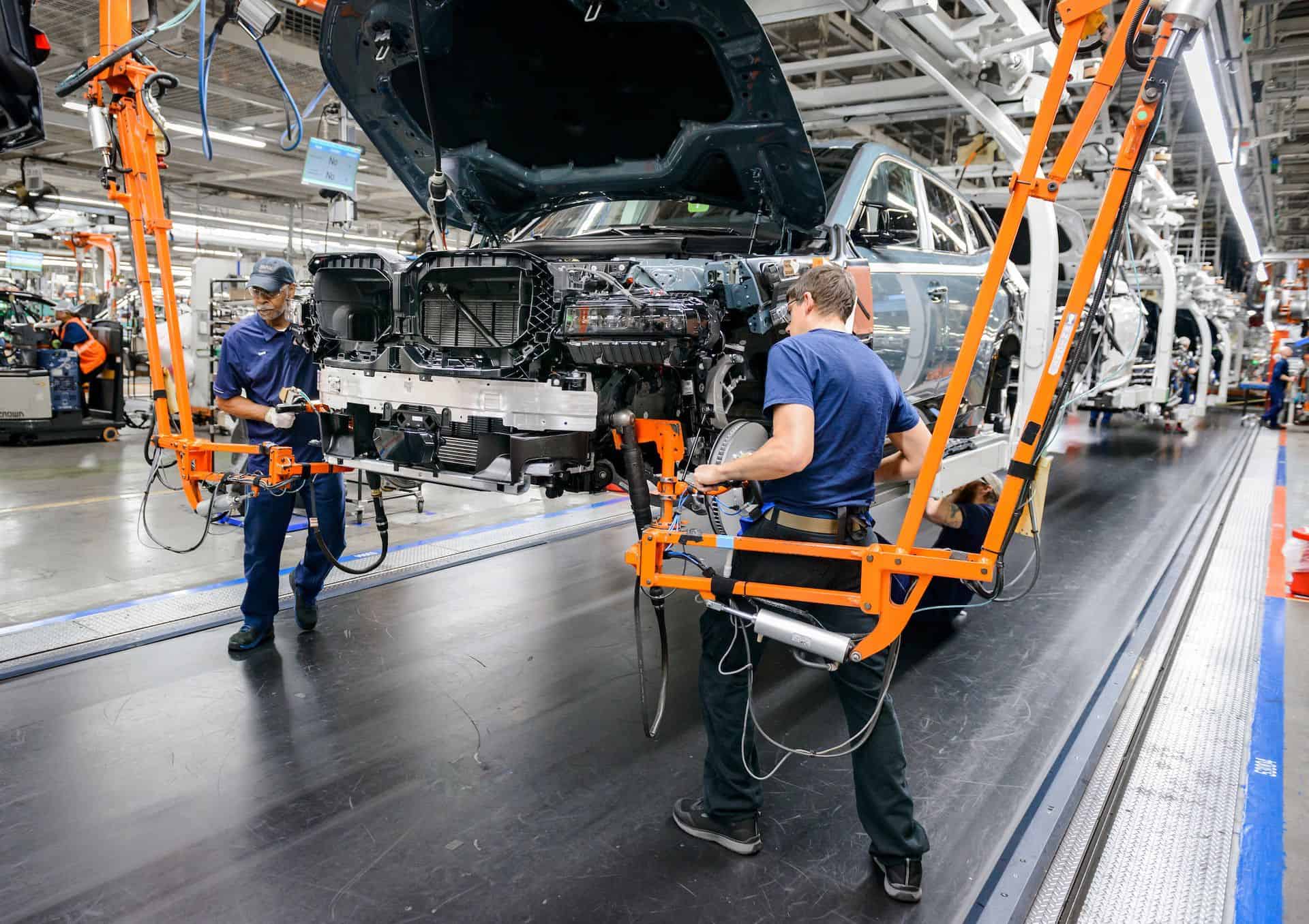
The Munich plant is in the midst of one of many most extensive rebuilds in BMW’s manufacturing network, and the work is occurring whereas the manufacturing facility continues working at full pace. Greater than 6,500 workers from over 60 nations hold the road shifting, and a brand new automobile leaves the road roughly each 60 seconds. In 2024, the plant constructed greater than 83,500 totally electrical BMW i4 fashions, exhibiting how shortly EV manufacturing has scaled inside a web site initially designed for combustion engines.
The problem now’s getting ready the plant for the Neue Klasse, which begins manufacturing in 2026, with out shutting down operations. As a result of the location is positioned in the midst of Munich and has no room to broaden outward, BMW has to rebuild from inside. Round 33 p.c of the present constructions will likely be dismantled, and roughly 600,000 tons of fabric have to be eliminated as older buildings come down. On the similar time, BMW is including about 70,000 sq. meters of recent ground house, contributing to a complete of 250,000 sq. meters of recent gross ground space as soon as the undertaking is full.

The brand new manufacturing halls are being designed as three-story buildings for meeting and physique store operations, a vertical method wanted to extend usable house on a plot that measures simply 500,000 sq. meters however already incorporates over 620,000 sq. meters of manufacturing space via stacked layouts. BMW has set an 18-month timeline from the beginning of deconstruction to the purpose when new expertise have to be put in for the Neue Klasse. To clear house, the corporate is finishing up 13 main relocations, shifting gear, logistics routes, and departments into short-term areas.
The logistics concerned in conserving the plant operational whereas development advances are substantial. Roughly 400 vans transfer out and in of the power every single day, transporting particles out and bringing development supplies in. BMW says the brand new constructions will meet an vitality customary of 40 p.c of the reference worth, a part of a broader effort to cut back emissions throughout its manufacturing community. General, there are 800 vans shifting out and in of the plant each single day, together with vans transporting elements or vehicles.
Few automotive crops try a change of this scale with out pausing manufacturing, and Munich’s constraints make the undertaking much more complicated.

Later within the morning, throughout a roundtable dialogue, Ilka Horstmeier, BMW’s Board Member for Folks and Actual Property, provided an outline that aligned precisely with what we had seen.
“It’s like an open-heart surgical procedure every single day,” she stated. “We’re remodeling this plant whereas we’re producing 1000 vehicles per day. It’s a logistical masterpiece… and that’s the way in which we run transformation at BMW — individuals, locations, manufacturing techniques. We predict all of them collectively.”
She spoke with the form of candor that comes from managing the human aspect of change as a lot because the operational aspect. Nowhere was that clearer than when she mentioned the closure of the Munich engine plant, which had operated for greater than seventy years. The transition required relocating or reskilling 1,200 workers — individuals whose identities have been formed by constructing combustion engines, from four-cylinders to V12s.
“There was additionally unhealthy information,” Horstmeier stated. “Folks like their jobs. They like to provide eight-cylinders, twelve-cylinders. However we managed that.”
She described how BMW created individualized paths for each worker, mapping out what their first day, first week, and first month would appear to be. Her takeaway was easy: “Belief is perhaps essentially the most invaluable forex in these transformative occasions.”
Contained in the Expertise Campus: Coaching for a Workforce That Has to Rework Rapidly

After the plant tour, this system moved a couple of minutes down the pedestrian walkway to BMW’s new Talent Campus, constructed on the footprint of the previous Munich engine plant. The ability is now the central coaching hub for roughly 40,000 BMW Group workers in Munich, and it displays the dimensions of the corporate’s workforce transition greater than any presentation may. BMW has invested greater than €1 billion in coaching and growth over the previous three years, and the Expertise Campus reveals the place that cash goes.

BMW at present brings in round 1,200 vocational trainees yearly, unfold throughout 30 totally different coaching professions and 18 twin examine packages. Recruiters instructed us the expertise pipeline has modified considerably up to now decade. The corporate now depends on new recruitment channels, early engagement with college students, and nearer relationships with vocational faculties and universities to safe younger technical expertise. Apprentices are introduced in earlier, retained earlier, and given clearer growth paths than up to now. The purpose is not only to fill open roles however to construct a workforce able to adapting as manufacturing strategies evolve.
The coaching ecosystem behind the Expertise Campus is international. BMW runs vocational packages in 20 manufacturing areas and branches worldwide, with the biggest networks in Germany, the UK, the U.S. and Hungary. Germany alone accounts for round 3,865 trainees, supported by partnerships with 66 faculties, together with 33 vocational faculties and eight universities. Throughout the broader community, BMW works with faculties within the U.S., the UK, Brazil, Thailand, China, and Hungary, together with vocational-technical faculties in Austria and Mexico. In whole, the corporate estimates about 1,163 trainees are energetic throughout its international Rolls-Royce and BMW Group areas.

Contained in the Munich Expertise Campus, the shift in coaching philosophy is straight away seen. Conventional workshop areas sit alongside digital coaching labs, robotics stations, automation techniques, and devoted areas for AI-based instruments. Apprentices rotate between VR welding simulators, robotic workstations, 3D printing areas, Microsoft Hololens environments, and CNC machining setups. Trainers discuss with this as “future expertise” growth — not simply instructing a commerce, however instructing workers to navigate expertise that evolves yearly.

BMW says greater than 75,000 workers per 12 months participate in {qualifications} associated to rising fields equivalent to high-voltage techniques, digital manufacturing instruments, and EV-related processes. Greater than 50,000 workers have already accomplished coaching particular to e-mobility. A lot of this work is completed in cooperation with universities, expertise companions, and different industrial corporations. Internally, BMW makes use of the Expertise Campus to pilot new tutorial strategies earlier than pushing them out to different crops worldwide.
Robotics and AI: Sensible Instruments Already Embedded within the Manufacturing facility
The ultimate cease of the day, the Robotics and AI Coaching Heart, provided a view into how digitalization is unfolding inside BMW’s crops. As an alternative of the massive industrial robots typically related to automotive manufacturing, we noticed collaborative robotic arms being skilled for particular duties — mild, versatile machines meant to help staff slightly than exchange them. Staff discover ways to program these models, methods to troubleshoot, and methods to adapt them to workstations the place repetitive pressure or precision necessities make automation helpful.
AI made an look, however once more, not in a futuristic or summary means. We noticed techniques used to research ergonomic posture by monitoring the human physique via motion, a technique initially developed for movement seize studios earlier than being tailored for office evaluation. BMW makes use of these measurements to revamp stations and cut back bodily pressure. In different rooms, defect-detection algorithms have been demonstrated — instruments that assist human inspectors by catching anomalies the attention might miss.
The constant message was that AI features as an assistant slightly than an authority.
BMW repeatedly stresses that its long-term competitiveness depends upon lifelong studying, and the construction of the Expertise Campus makes that time clear. The corporate is just not coaching workers for one job title or one part of the trade. It’s making an attempt to organize them for a producing panorama that can proceed altering as electrification, software program integration, and round manufacturing reshape the work carried out inside BMW’s crops.
A Technique That Adapts As an alternative of Predicts
One thread working via the displays was BMW’s refusal to commit fully to a single technological final result. Horstmeier expressed this plainly throughout a strategic dialogue, acknowledging the uncertainties going through the trade. “We don’t put all eggs in a single basket,” she stated. “Instances are unstable… The conditions for 100% electrical even in Europe should not there and won’t be there till the 2030s.”
Her level wasn’t anti-electric. It aligned with what we noticed up to now: factories being redefined so it might deal with new electrical platforms whereas nonetheless supporting combustion-engine traces for markets that want them. BMW’s method isn’t about guessing the long run; it’s about constructing flexibility into the system so the corporate can transfer with it.
A Transformation Held Collectively by Folks
By the point we left the robotics heart late within the day, the widespread thread was fairly apparent. All the brand new expertise, infrastructure, and development mattered, however what tied your entire occasion collectively have been the individuals doing the work.
Horstmeier returned so far repeatedly: “Transformation with our individuals is feasible,” she stated earlier within the day.
BMW Traditional: A Have a look at the Artwork Vehicles and the Cultural Aspect of the Model

The primary day concluded at BMW Group Traditional, the place the corporate shifted the main target from manufacturing and coaching to its long-running cultural packages. BMW used the setting to focus on the Artwork Automotive assortment, a undertaking that dates again nearly 5 many years and has concerned artists from all over the world.
Thomas Girst, BMW’s Head of Cultural Engagement, walked us via the historical past of the Artwork Vehicles and defined how this system has developed alongside the model. Girst offered two important items from the gathering: the Alexander Calder Art Car, the primary automobile created for the sequence in 1975, and Art Car No. 20, designed by Julie Mehretu and unveiled earlier this 12 months.

Girst emphasised that the Artwork Automotive undertaking has by no means been about advertising however about long-term collaborations with artists who reinterpret BMW’s design language via their very own lens. Seeing Calder’s authentic work subsequent to Mehretu’s newest entry underlined how this system has maintained continuity whereas permitting vastly totally different inventive approaches.

The go to added a cultural dimension to the Accountability Days program, exhibiting how BMW frames its industrial transformation inside a broader context that features design, heritage, and inventive partnerships. Keep tuned for the third installment of the BMW Accountability Days which features a go to to the brand new battery plant in Irlbach-Straßkirchen, adopted by a final cease in Landshut.
[Photos: Rainer Haeckl © BMW AG]
Trending Merchandise

Hiseanllo Car Seat Gap Filler 2 Pack, Univers...

Mandark 4PCS Car Cup Holder Coasters, 2.75 In...